
You don't have to wait for a problem to make the switch. Setup takes a day, not weeks. You keep your current number. Your team adapts faster than you'd expect.
You've been looking at business phone systems for a while. Maybe you got a quote for a new traditional PBX and nearly fell off your chair. Maybe someone told you to look at Cloud PBX and you want to understand what you'd actually be giving up. Either way, you're at the fork in the road.
The vendors don't help. Traditional suppliers talk about reliability and "proven technology." Cloud providers throw around words like "scalable" and "future-proof." Everyone's trying to sell you something, and none of them are being straight about the trade-offs.
So here's an honest comparison — what each system actually is, what it actually costs, where each one genuinely has the edge, and which one makes more sense for most South African businesses right now.
What is a traditional PBX?
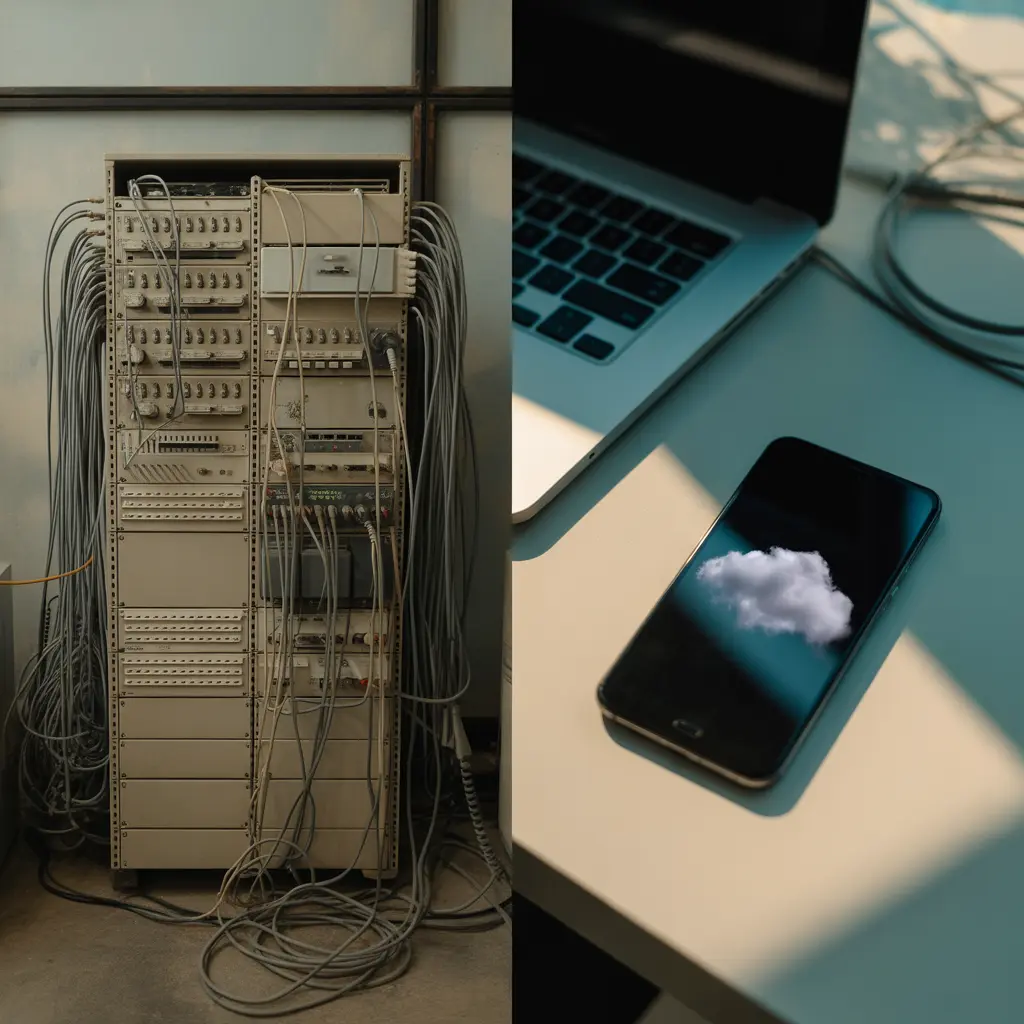
A traditional PBX is a physical phone system that sits in your building — usually a rack unit in a server room or comms cupboard — and manages all your calls. Incoming, outgoing, internal extensions, hold music, the works.
Getting one installed means paying a supplier upfront for the hardware. Depending on the size of the system and how many users you need, that's typically R20,000 to R150,000 before you've plugged anything in. Then you add Telkom line rental on top, pay a monthly maintenance contract, and hope nothing breaks.
When something does break — and eventually it will — you call a technician and wait. Want to add a new staff member? Technician. Moving offices? Technician, and quite possibly a whole new system. Want to change your after-hours greeting? Depends on the system, but often: technician.
The hardware works. The technology is mature. The problem is that it was designed for a world where everyone worked in the same building, power was reliable, and phone infrastructure hadn't changed in 30 years. That world is gone.
What is Cloud PBX?
A Cloud PBX does everything a traditional PBX does — routing calls, managing extensions, handling an auto-attendant, recording calls — but the hardware isn't in your building. It lives in a data centre, managed by your provider.
You connect to it over the internet. Your phones can be proper IP desk phones if you want them, but they can just as easily be an app on your team's laptops or mobile phones. Someone calls your business number, it hits the cloud, and your settings tell it where to go — ring the sales team, go to voicemail after 30 seconds, forward to mobile after hours. All of it configured through a browser, by you, whenever you want.
No hardware to buy. No technician to call when you want to make changes. Add a new staff member in two minutes. Remove one just as fast.
If you're new to the concept and want a full explainer on how it works, we've written a plain-English guide to Cloud PBX here →.
The comparison: side by side
Here's where the two systems actually differ. No fluff — just the numbers and facts.
Traditional PBX | Cloud PBX | |
|---|---|---|
Upfront cost | R20,000–R150,000+ | Minimal to none |
Monthly cost | Line rental + maintenance contract | Per-user subscription (all-in) |
Setup time | 2–6 weeks | 1–2 days |
Hardware on site | Required | Optional |
Adding a user | Hardware + technician | A few clicks, immediate |
Moving offices | Major project, often new hardware | Nothing changes |
Remote / hybrid work | Limited, often complex | Built in — works anywhere |
Load shedding | Fails with your office power | Stays live, calls route to mobile |
System maintenance | Your responsibility | Provider's responsibility |
Software upgrades | Infrequent, expensive | Continuous, included |
Contract length | Often 3–5 years | Usually month-to-month |
The cost column alone is enough to make most SME owners take notice. But in South Africa specifically, that load shedding row deserves more than a line in a table.
When traditional PBX still makes sense
Let's be honest about this, because most Cloud PBX providers aren't.
Very large enterprises with complex, specialised requirements. If you're running a 500-seat contact centre with highly customised call routing, legacy system integrations, and dedicated IT staff to manage everything, there are scenarios where on-premise infrastructure gives you more control. That said, even at that scale, most businesses are moving to cloud.
Locations with genuinely unreliable internet connectivity. Cloud PBX runs over the internet — that's the whole point. If you're operating from a site where fibre isn't available and LTE coverage is patchy, a traditional system may be more predictable for your primary phone line. For most urban South African businesses this isn't the situation, but it's worth acknowledging.
Businesses that installed a system recently. If you had a traditional PBX put in two years ago and it's working well, there's no urgent reason to rip it out. Your money is spent. When the hardware approaches end of life — or when the next upgrade quote arrives — that's the time to have the conversation again.
That's the honest list. These cases apply to a small minority of South African SMEs.
When Cloud PBX is the better choice
For most businesses — and this genuinely covers the large majority of South African SMEs — Cloud PBX wins on almost every dimension that matters.
You're setting up from scratch. If you're opening a new office or starting a new business, there's no argument for buying a traditional PBX. The upfront cost alone settles the question before you even get to the other benefits.
Your team isn't all in one place. A traditional PBX in your Johannesburg office doesn't ring through to the person working from home in Pretoria, or to your Cape Town sales rep. Cloud PBX does — same number, same system, wherever they are. This has gone from a nice-to-have to a basic requirement for most businesses.
You need to scale up or down. Growing from 8 staff to 25? With a traditional system, that's a conversation about hardware upgrades. With Cloud PBX, you add users when you need them and remove them when you don't. Month-to-month. No long-term commitment.
You're on Telkom lines and want out. Plenty of businesses that switch to us are escaping Telkom business line contracts — the costs, the inflexibility, the support experience. Cloud PBX over SIP replaces those lines entirely. You keep your existing number, monthly costs come down, and you don't need to deal with Telkom for your phone service anymore. Most don't look back.
Business continuity matters to you. This is the one that South African businesses understand better than anyone else in the world. When load shedding hits, a traditional PBX goes down with everything else. Your Cloud PBX doesn't.
The load shedding question nobody answers properly
Most comparisons you'll find online are written for UK or US businesses. They cover cost savings and remote work. They don't mention Eskom, because they don't have to.
South African businesses do.
Load shedding is an operational problem for any business that depends on incoming calls. Not a minor inconvenience — a genuine risk to revenue. Your phone is how customers reach you. It's how sales happen. It's how your support team keeps clients from churning.
A traditional PBX with a good UPS might give you an hour of backup power. Maybe two on a generous day. That's not going to cover you through a Stage 5 or Stage 6 rotation.
A Cloud PBX lives in a data centre with enterprise-grade backup generators and redundant power. Those servers don't go down when Eskom does. And when your office loses power, you haven't lost your phone system — calls automatically route to your team's mobile apps instead. Your customers still get through. Your business still answers.
This played out for dozens of our clients during the extended outages in 2023 and 2024. The businesses on cloud systems kept operating. The ones on traditional PBX had to field calls on personal cell phones, apologise to clients, or go unreachable entirely.
It's not a theoretical advantage. For a South African business, it's arguably the most important reason to make the switch.
The verdict for South African SMEs
If you're genuinely sitting at this decision point in 2026, here's the short version.
Traditional PBX made sense when it was the only serious option. It's a mature, functional technology. But the economics have shifted, the way businesses work has changed, and load shedding has added a resilience dimension that tips the calculation firmly in one direction.
Cloud PBX gives you everything a traditional system gives you — call routing, extensions, auto-attendants, call recording, ring groups — plus genuine remote work capability, no maintenance overhead, no large upfront cost, and a phone system that keeps running when the power doesn't.
The businesses that are still on traditional PBX are mostly there because of inertia, not because it's the better choice. When the hardware needs replacing — or when the next technician callout quote arrives — that's usually when the decision gets made.
You don't have to wait for a problem to make the switch. Setup takes a day, not weeks. You keep your current number. Your team adapts faster than you'd expect.
Ready to make the switch?
Othos is a South African Cloud PBX provider — ICASA licensed, based in Cape Town, running on AWS infrastructure with the redundancy that comes with it. We work primarily with SMEs, and our setup process is built to get you live quickly, without requiring an IT department.
Month-to-month contracts. Setup in a day. Support that actually picks up.
Talk to us about your current setup →
Related reading:
What Is Cloud PBX? A Plain-English Guide for SA Businesses →
VoIP for Small Business in South Africa: Everything You Need to Know →